Black Lagoon: A World Without a Flag
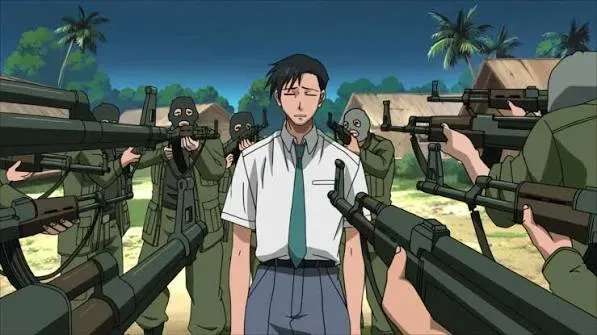
Rokuro Okajima is not a soldier. He is a different kind of service person—a salaryman carrying a company disk across the South China Sea. The Lagoon Company boards the vessel with the efficiency of people who no longer answer to any chain of command. Guns appear. The disk is taken. Okajima is taken with it. The decision is casual. That casualness is the first signal that the structures he has spent his adult life serving no longer apply.
Aboard the Black Lagoon the hierarchy reveals itself without ceremony. Dutch captains the boat. The posture is unmistakable: the measured voice, the refusal to waste motion, the quiet certainty that the vessel will hold. These are not the habits of a man who learned his trade only in the underworld. Somewhere behind them sits earlier service—riverine work, a war that ended without bringing him home. The series never dwells on the discharge or the decision not to return. It simply shows the result. The competence remains. The cause does not. He runs a pirate crew the way a man might still run a unit that has been left without a flag.
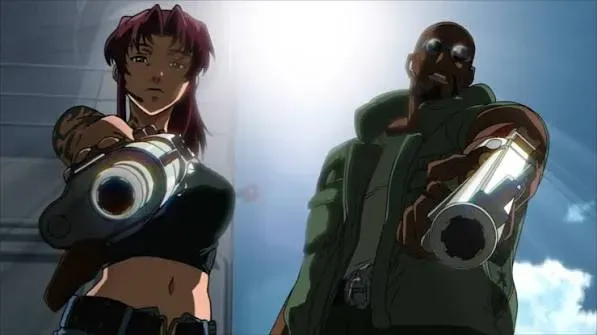
Beside him moves Revy. She is not a product of formal service. Her training came from a different kind of battlefield—an abusive home in New York’s Chinatown, the moment she ended the violence by matching it, the years of survival that followed. Yet she belongs to the same pattern. Institutions failed her early. The only structure that remained was the one she built around the weight of a pistol in each hand. The dual-wielding is not style. It is the residual language of someone who learned that no larger body would protect her.
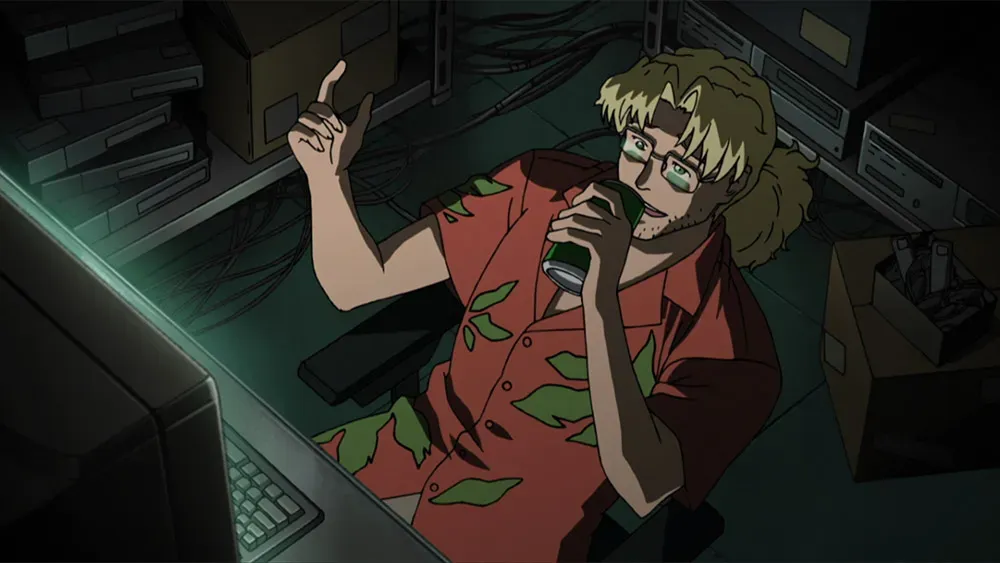
Somewhere below deck Benny keeps the electronics running. A student with technical skill who attracted the simultaneous attention of the law and the people the law could not control. The rescue that brought him to the boat was also a severance. The same mind that once belonged to ordinary academic life now keeps the crew alive. He does not speak of what was lost. He simply continues working inside the only structure that still claims him.
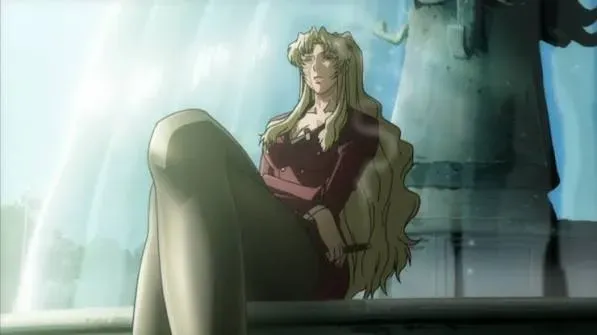
The disk is delivered to Balalaika. She receives it with the calm of someone who has already paid for the outcome she wants. Her presence is not loud. It is complete. The scars on her face are not decoration. They are the visible record of a different kind of service—Soviet airborne forces, the war in Afghanistan, a unit trained for precision and loyalty to a state that would later abandon them. After the collapse she gathered what remained of her men and gave them a new purpose under a different kind of command. Hotel Moscow is not nostalgia. It is reconstruction after institutional betrayal. The soldier’s competence remains. The state that once owned it does not.
The company that employed Okajima chooses to declare him dead rather than negotiate further. The choice is clean on paper and absolute in effect. The man who once measured his days by office hours is left standing in Roanapur with no remaining claim on the life he left behind.
He stays.

The decision is not framed as destiny. It is framed as the only remaining door that is still open. He is given a new name—Rock—and a new function: the voice that can still speak the language of contracts and faces in a city that prefers other methods. The duality is immediate. The same skills that made him useful to a corporation now make him useful to pirates. The man who once absorbed humiliation from superiors begins to learn when silence is more dangerous than speech. He has joined the company of people who were once claimed by larger structures and then discarded by them.
The series never pauses to lecture on these trajectories. It simply places the characters inside jobs that force the before and after into the same frame. A delivery that turns into a firefight. A negotiation that requires the residual politeness of a salaryman and the residual ruthlessness of a woman who learned early that strength is the only reliable currency. A child assassin whose existence forces Rock to confront how far the new life has already rewritten the old one. Each arc tightens the same question: what remains of a person once the institution that defined them has cut them loose.
Dutch carries the quiet of a man who already answered that question years ago. Balalaika answers it with absolute control over the unit she rebuilt from the wreckage. Revy answers it with the constant readiness of someone who never expected institutions to hold. Rock is still answering it in real time, learning the cost of every compromise the new world demands.

Madhouse’s adaptation understands the weight of these transitions. The animation does not linger on backstory. It lingers on the present-tense consequences—the way Rock’s posture changes when he realizes he can no longer return, the way Revy’s violence tightens when the past threatens to surface, the way Balalaika’s stillness contains both the officer and the crime lord without contradiction. The studio trusts the viewer to feel the fracture without needing it explained.

Near the end of any sustained engagement with the work, the question that remains is not whether these people can be redeemed. The series has little interest in redemption as a narrative goal. The question is whether a person can continue to function once the original map has been burned and the institution that issued it has already walked away. Rock’s answer is still forming. The others have already chosen theirs and live inside them without apology.
Rei Hiroe’s earlier work—Phantom Bullet, the unfinished Hisuikyō Kitan, the later 341 Sentōdan—returns repeatedly to people whose original frameworks have collapsed and who must then invent new ones under pressure. The same measured intensity that defines Black Lagoon can be felt in those pieces, even when the settings differ. Readers who respond to the quiet examination of what institutional abandonment and displacement do to identity will find the same unsentimental gaze waiting there.
What lingers after the final confrontation is not the body count. It is the image of people who once served larger structures—armies, corporations, states—and who now stand on a boat that answers to no flag, still carrying the competence those structures trained into them, long after the structures themselves have disappeared.
Couch talk
Quiet on this thread so far — say something (we mod before it goes live).